Modern traffic legislation across the Kingdom of Saudi Arabia is structured to safeguard human lives and protect property; however, technical calibration errors within automated speed detection and surveillance cameras occasionally occur. Consequently, exercising the legal right to contest traffic violations constitutes an essential statutory mechanism enabling every motorist to eliminate unjustified financial liabilities and administrative sanctions while guaranteeing prompt justice under the Implementing Regulations of the Saudi Traffic Law. The Law Firm of Abdulaziz Mutlaq Eqab Al-Qablan provides this comprehensive guide to clarify approved administrative frameworks and statutory conditions governing traffic infraction appeals to protect the rights of motorists and commercial fleet operators.
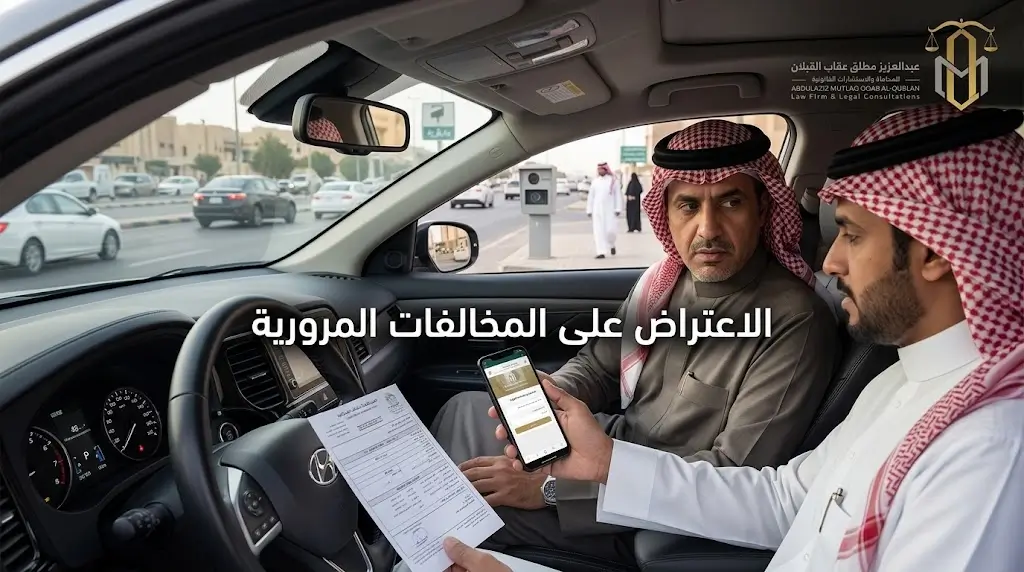
The right to contest traffic violations is defined as a formal legal prerogative entitling vehicle operators to appeal registered fines via the Absher electronic portal within thirty days from the violation recording date, provided the fine has not been settled in advance and the petitioner furnishes valid technical or legal grounds admissible before specialized Traffic Adjudication Committees charged with evaluating digital records and empirical evidence.
- Statutory Framework Governing the Right to Contest Traffic Violations
- Prerequisites and Formal Conditions for Admissibility of Appeals
- Step-by-Step Procedure to Contest Traffic Violations via Absher
- Drafting a Standardized Legal Appeal Memorandum for Traffic Fines
- Identifying Grounds for Appeal Rejection and Preempting Procedural Dismissals
- Traffic Inquiries and Absher Digital Regulatory Services
- The Strategic Role of Legal Counsel in Drafting Appeals and Preserving Rights
- Navigating and Resolving Complex Traffic and Administrative Disputes
- Statutory Timelines and Mandatory Limitation Windows for Appeals
- Specialized Legal Consultations for Contesting Fines
- Frequently Asked Questions
- Conclusion
Statutory Framework Governing the Right to Contest Traffic Violations
The statutory entitlement to contest traffic violations derives directly from the Saudi Traffic Law and its Implementing Regulations, which guarantee citizens and residents the procedural right to challenge administrative decisions before specialized quasi-judicial administrative committees.
The Saudi legal regime guarantees every vehicle driver the absolute right to challenge the accuracy of recorded infractions, whether captured via automated enforcement infrastructure (such as Saher cameras) or physical citations issued on-site by field patrol units. Legal counsel at the Law Firm of Abdulaziz Mutlaq Eqab Al-Qablan affirm that the legislature instituted clear safeguards governing this entitlement to prevent abusive filings while eliminating arbitrary determinations and technical recording errors. Successfully navigating this process requires thorough familiarity with statutory articles delineating administrative and civil tort liability for motorists, alongside continuous monitoring of operational directives issued by the General Directorate of Traffic. Our legal team provides strategic counsel ensuring clients fully grasp their legal rights and direct their filings through correct procedural channels, working closely with an accredited corporate commercial attorney to manage transportation fleet infractions.
📞 Call Us |
Prerequisites and Formal Conditions for Admissibility of Appeals
Admissibility of an application to contest traffic violations requires that the submission be lodged within thirty days from system entry, that the underlying citation remains unpaid, and that verified factual, technical, or legal grounds corroborate the appeal before review bodies.
Administrative traffic appeals must satisfy stringent formal and substantive conditions designed to eliminate vexatious or untimely submissions. Core statutory prerequisites encompass:
- Statutory Deadline: The petition must be formally registered within a mandatory limitation window of 30 days from the date the violation was logged into the digital database.
- Settlement Status: The disputed fine must remain unpaid; settling the penalty operates as an implied admission of liability, forfeiting the petitioner’s right to challenge the citation.
- Filing Frequency Limits: A motorist cannot contest the exact same recorded violation more than once via digital platforms following an official, definitive decision rendered by the committee.
- Data Consistency: Motor vehicle characteristics, registered plate identifiers, and petitioner national records must align with Ministry of Interior databases.
The team at the Law Firm of Abdulaziz Mutlaq Eqab Al-Qablan audits these criteria prior to initiating formal procedures, maximizing prospects for a favorable resolution.
Step-by-Step Procedure to Contest Traffic Violations via Absher
The procedure to contest traffic violations is conducted digitally by logging into the Absher Individuals portal, navigating to “My Services,” selecting “Traffic Services,” choosing the objection service, selecting the designated citation, attaching technical grounds, and submitting the request.
Digital transformation within the Kingdom has streamlined administrative processes, permitting beneficiaries to submit regulatory appeals with high flexibility. The standard procedural workflow comprises:
- Authenticate digital access on the Absher Individuals portal via National Single Sign-On credentials and verify the one-time passcode.
- Navigate to the “My Services” tab and access the “Traffic” division.
- Select “Contest Traffic Violations” to display the roster of currently registered infractions.
- Select the specific citation to be appealed and review associated photographic proof or technical telemetry data.
- Formulate the legal justification, articulate precise technical defense arguments, confirm submission, and record the issued tracking number for judicial follow-up.
| Procedural Phase | Operational Platform | Technical Prerequisites | Anticipated Adjudication Timeline |
|---|---|---|---|
| Inquiry & Verification | Absher / Tawakkalna Portals | Active verified digital account | Instantaneous |
| Appeal Submission | Absher (Traffic Services) | Articulated statutory defenses | Within 30 days of infraction log |
| Substantive Assessment | Traffic Adjudication Panel | Digital proof & camera calibrations | 5 to 15 business days |
| Final Ruling Issuance | Absher / SMS Notifications | Formal dismissal or cancellation order | Immediately upon certification |
Drafting a Standardized Legal Appeal Memorandum for Traffic Fines
Drafting an effective traffic appeal requires incorporating verified personal credentials, citation reference numbers, infraction recording dates, and clear technical or legal defenses (such as plate transcription errors or emergency conditions), avoiding generic or ambiguous statements.
The success of an administrative challenge frequently rests upon substantive drafting and persuasive evidentiary presentation. The Law Firm of Abdulaziz Mutlaq Eqab Al-Qablan provides the following model appeal to illustrate standard procedural drafting:
“To the Honorable Chairman of the Traffic Adjudication Committee, Greetings.
I, the undersigned (Full Name: ……………….., National ID / Iqama: ………………..), in my capacity as owner and operator of motor vehicle license plate number (…………), hereby submit a formal objection against the traffic violation recorded under Reference Number (…………….) dated …….. AH, categorized as (Specify violation: e.g., Disregarding Traffic Signals / Exceeding Statutory Speed Limit).
Whereas the cited infraction was registered during an interval wherein I was subject to verified force majeure conditions / or attributable to an evident technical calibration error in automated license plate optical recognition due to (concisely articulate technical grounds), the alleged offense did not materialize as established by factual and technical records.
Therefore, I respectfully petition the Committee to accept this objection in form and substance, vacate the cited infraction, and expunge the associated financial penalty. With sincere appreciation.”
Identifying Grounds for Appeal Rejection and Preempting Procedural Dismissals
Primary catalysts for appeal rejections include submitting challenges after the 30-day statutory window, prior settlement of the penalty, failure to furnish technical or factual corroboration, or incontrovertible automated photographic evidence substantiating the infraction.
Numerous administrative objections face dismissal due to formal deficiencies that could be averted through skilled legal guidance. Key dismissal grounds and corresponding mitigation methods include:
- Lapse of Statutory Timelines: Preempted by filing the petition immediately upon receipt of electronic citation notices.
- Challenging Unappealable Infractions: Inapplicable where statutes dictate definitive finality or where the petitioner has paid the fine.
- Deficient Factual Justifications: Relying on vague assertions without demonstrating the technical error; cured through precise evidentiary framing.
- Contradicting Official Records: Submitting claims that conflict directly with telemetry data and digital imaging archived in traffic databases.
Retaining the legal team at the Law Firm of Abdulaziz Mutlaq Eqab Al-Qablan ensures rigorous review of appeal materials prior to final submission, minimizing the risk of adverse rulings.
📞 Call Us |
Traffic Inquiries and Absher Digital Regulatory Services
The Absher system enables real-time inquiries into traffic violations indexed under National ID, Iqama, or Border numbers, displaying violation timestamps, precise geospatial coordinates, and captured digital photographs to assess whether grounds exist to lodge a formal challenge.
Conducting a comprehensive preliminary inquiry represents the first phase in administrative traffic review. Digital platforms maintained by the Ministry of Interior allow parties to access full operational parameters governing fines linked to civil registries or commercial driving records. Through the Absher interface, users can audit total sums owed, historical dates, and exact operational locations. Practitioners at the Law Firm of Abdulaziz Mutlaq Eqab Al-Qablan emphasize archiving these data logs, telemetry screenshots, and transaction numbers when escalating claims before quasi-judicial committees, coordinating with a dedicated financial claim litigation attorney when civil tort damages or financial liabilities emerge.
The Strategic Role of Legal Counsel in Drafting Appeals and Preserving Rights
Retaining qualified legal counsel provides substantial advantages through the rigorous drafting of formal memoranda, challenging automated camera calibrations, and appearing before review panels to prevent procedural dismissals.
Engaging specialized administrative and traffic litigators affords clients an indispensable strategic advantage. In complex traffic disputes, individual appeals often fail to convince committees to cancel penalties arising from automated sensor errors or unusual road conditions. Retaining counsel through the Law Firm of Abdulaziz Mutlaq Eqab Al-Qablan as an accredited legal consultation firm ensures your case is handled systematically under the supervision of a licensed lawyer in Riyadh. Our legal team examines the factual record, structures persuasive legal briefs grounded in the Traffic Law and its Implementing Regulations, and manages the objection process through final administrative determination.
Navigating and Resolving Complex Traffic and Administrative Disputes
Complex traffic disputes involving serious vehicular collisions, accumulated corporate fleet fines, or intersecting administrative and penal liabilities require sophisticated counsel to protect the client’s commercial standing.
Traffic litigation is not restricted to standard automated speed cameras; it frequently extends into intricate administrative, civil, and criminal proceedings requiring advanced courtroom experience before the Administrative Judiciary (Board of Grievances), Traffic Adjudication Committees, Criminal Circuits, and Commercial Courts when transport contracts, freight delays, and risks of submitting an enforcement application against bank accounts arise. This encompasses collisions involving complex tort liability assessments, joint driver negligence disputes, and citations issued to disabled fleet vehicles on highways. The Law Firm of Abdulaziz Mutlaq Eqab Al-Qablan delivers comprehensive legal solutions to manage these disputes, framing substantive defenses before specialized panels and petitioning appellate benches to overturn erroneous administrative rulings.
Statutory Timelines and Mandatory Limitation Windows for Appeals
Strict compliance with statutory limitation windows is paramount for the admissibility of traffic objections; the Traffic Law sets a maximum 30-day deadline, upon the expiration of which procedural rights lapse absent an acceptable legal justification.
Strict adherence to statutory limitation periods constitutes the foundation of any administrative appeal. Exceeding the established 30-day period without presenting a valid statutory excuse accepted by review committees results in the forfeiture of the right to appeal and renders payment of the fine mandatory. Practitioners at the Law Firm of Abdulaziz Mutlaq Eqab Al-Qablan stress the importance of reviewing administrative notifications immediately upon transmission rather than leaving citations unattended. Our firm advises corporate and individual clients to institute routine auditing protocols across digital portals, lodging objections promptly whenever improper ticketing is detected.
Specialized Legal Consultations for Contesting Fines
Retaining specialized legal consultations enables beneficiaries to evaluate their regulatory exposure, determine appeal success probabilities, and identify optimal administrative channels to preserve their assets.
Securing an expert legal consultation early safeguards clients against procedural pitfalls and unwarranted financial liabilities. Amidst intricate traffic statutes, obtaining the guidance of a qualified practitioner provides clear direction on your legal standing. The Law Firm of Abdulaziz Mutlaq Eqab Al-Qablan delivers tailored legal advisory services to corporate enterprises and individuals, addressing all facets of traffic and administrative disputes while implementing actionable strategies to handle citations under statutory frameworks.
📞 Call Us |
Frequently Asked Questions
What is the statutory limitation period to contest a traffic violation in Saudi Arabia?
The approved statutory period is strictly 30 calendar days from the date the infraction is logged into the digital traffic system; objections submitted after this window are inadmissible absent a valid justification accepted by the committee.
Can I submit an objection against a traffic violation that has already been paid?
No. Statutory rules prohibit contesting an infraction once payment has been processed, as settlement constitutes an admission of the violation and extinguishes the right to pursue an administrative appeal.
What are the primary grounds resulting in the rejection of traffic violation objections?
Common grounds for rejection include exceeding the mandatory 30-day window, prior fine payment, lack of technical or legal evidence supporting the claim, and definitive automated photographic proof verifying the infraction.
Can I retain legal counsel to contest traffic violations on my behalf?
Yes. You can appoint an accredited law firm such as the Law Firm of Abdulaziz Mutlaq Eqab Al-Qablan to represent your interests, structure formal memoranda, and pursue administrative appeals before competent bodies.
How can I verify the accuracy of a Saher automated speed camera violation?
You can log into the Absher portal, open the infraction details, and inspect the high-resolution digital image to verify that the vehicle plate numbers, timestamp, and recording location correspond accurately to your vehicle.
Does the Absher platform allow modifications to an appeal after final submission?
No. The portal does not allow alterations once an objection has been officially transmitted; consequently, you should review all supporting arguments and documentary evidence thoroughly prior to confirming your submission.
Conclusion
If your business or household faces improper traffic penalties or seeks to preserve its regulatory standing while preventing procedural dismissals, consulting specialized administrative and traffic litigators is essential. Retain professional counsel to contest traffic violations through the Law Firm of Abdulaziz Mutlaq Eqab Al-Qablan to ensure your legal rights are defended under Saudi statutory standards. Visit our official website (amq.com.sa) or contact our office directly at 0539999894.