Company formation in the Kingdom of Saudi Arabia goes far beyond merely obtaining a paper document or issuing a commercial registration from a digital portal. Modern enterprises are built on precise contractual frameworks that define the boundaries of financial and operational liability and separate managerial authority from equity and share ownership. Choosing the wrong legal structure or relying on standardized digital templates constitutes a regulatory risk that exposes the founders’ personal assets to the obligations and debts incurred by the corporate entity.
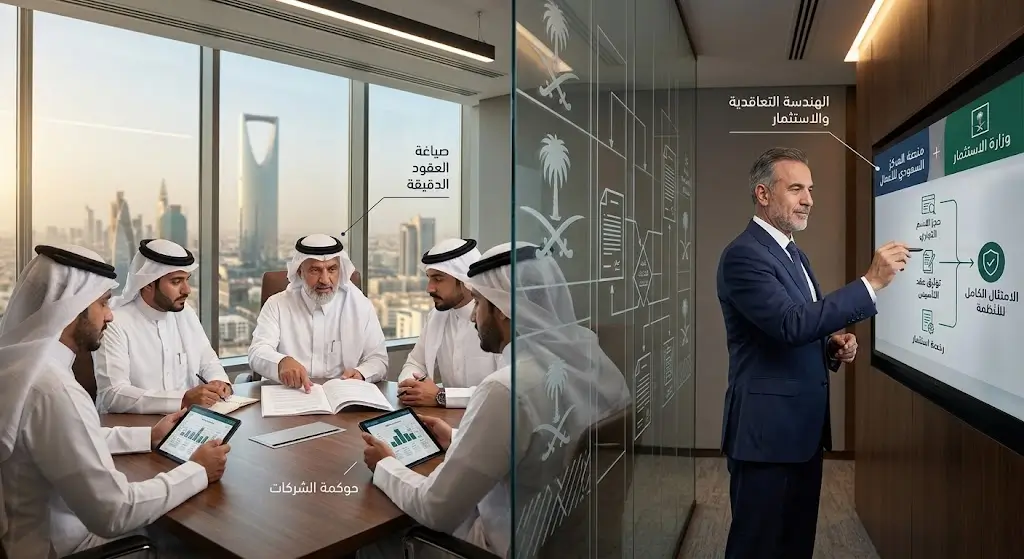
A specialized legal counsel in Saudi corporate law compliance leads the end-to-end contractual structuring for domestic and foreign investment companies. This guidance is grounded in the latest legislative updates under the new Saudi Companies Law, aligning with the advanced commercial ecosystem and the Kingdom’s economic vision to attract capital and guarantee partner and shareholder rights.
- Executive guide: company formation lawyer roles & duties
- Why hire an expert corporate attorney in Riyadh, Saudi?
- Business structures under the new Saudi Companies Law
- Rules for establishing a limited liability company Riyadh
- Setting up a simple joint-stock company in Saudi Arabia
- Rules and protections for single-person companies in KSA
- Company incorporation via Saudi Business Center portal
- Foreign company registration and MISA investment licenses
- Drafting articles of association and management powers
- Business conversion, holding and professional entities
- Government fees and minimum capital requirements in KSA
- Tax, Zakat, and labor compliance after incorporation
- Corporate governance to prevent shareholder disputes
- Selecting the best company formation lawyer in Riyadh
- Frequently Asked Questions
- Request specialized legal counsel for company formation
- Conclusion
Executive guide: company formation lawyer roles & duties
A company formation lawyer selects the optimal corporate structure to protect the founders’ assets, secures investment licenses from the Ministry of Investment, and drafts bespoke articles of association and bylaws rather than relying on generic templates. They also oversee governmental integration with the Zakat, Tax and Customs Authority, draft governance frameworks, and incorporate exit and dispute resolution clauses to prevent shareholder deadlock or court-mandated freezes.
The law firm oversees multiple workstreams to ensure complete regulatory compliance:
- Pre-incorporation structural evaluation: Assessing project commercial viability and cash flows to determine whether a limited liability company, a simple joint-stock company, or a foreign branch is ideal.
- End-to-end procedural representation: Reserving commercial trade names, filing registration requests via the Saudi Business Center portal, and aligning licensing criteria on the Invest Saudi platform.
- Contractual engineering and internal policies: Drafting shareholders’ agreements, internal oversight committee charters, and setting executive financial signature thresholds.
- Tax and Zakat compliance: Coordinating incorporation filings with Zakat, Tax and Customs Authority regulations to avoid penalties for late registration or non-disclosure of ultimate beneficial owners.
📞 Call Us |
Why hire an expert corporate attorney in Riyadh, Saudi?
Retaining a specialized corporate attorney shields entrepreneurs and foreign investors from the pitfalls of generic online contract templates that lack dispute settlement mechanisms and governance clarity. An attorney erects a corporate veil separating the partner’s personal wealth from company liabilities, prevents debt transfer to personal estates, and regulates share transfers under exclusive statutory mechanisms.
Digital platforms provide standardized statutory templates that do not reflect unique partnership dynamics. Rigorous legal customization safeguards strategic corporate interests through:
- Preventing management deadlocks: Establishing binding mechanisms for equal 50/50 shareholding splits through mandatory buy-sell options (Russian roulette provisions) or institutional arbitration via the Saudi Center for Commercial Arbitration.
- Intellectual property and intangible asset protection: Ensuring proprietary trade secrets, patents, and client lists registered under an individual partner are protected from unauthorized transfer via non-compete and non-disclosure clauses in the constitutional documents.
- Defining managerial authority: Restricting executive powers so managers cannot pledge company real estate, secure facilities exceeding agreed thresholds, or execute personal guarantees without explicit general assembly approval.
Business structures under the new Saudi Companies Law
The Saudi Companies Law provides distinct business forms suited for diverse commercial operations. The limited liability company and the simple joint-stock company remain the most flexible corporate vehicles for startups and small-to-medium enterprises, featuring no statutory minimum capital and strict liability shields.
| Legal Structure | Minimum Founders | Minimum Capital | Legal Liability | Key Operational Advantage |
|---|---|---|---|---|
| Limited Liability Company (LLC) | 1 to 50 partners | No statutory minimum (sufficient for scope) | Limited to partner’s capital contribution | Recognized model trusted by banks and financial institutions |
| Simple Joint-Stock Company (SJSC) | 1 or more shareholders | No statutory minimum (1 SAR or more) | Limited to the value of owned shares | Flexibility to issue multiple share classes without a mandatory board |
| Single-Person LLC | 1 owner (natural or corporate) | No statutory minimum | Limited to allocated company capital | Complete legal separation of personal wealth from business liabilities |
| Closed Joint-Stock Company | 2 or more shareholders | 500,000 SAR | Limited to the nominal value of subscribed shares | Ideal for large family businesses and IPO preparation on Nomu or TASI |
| Foreign Company Branch | Parent foreign entity | No local capital requirement | Unlimited liability extending to foreign parent | Allows international firms to operate without a local sponsor |
Rules for establishing a limited liability company Riyadh
The limited liability company remains the prevailing corporate vehicle for commercial businesses. It shields investor personal estates; a partner’s financial liability is strictly capped at their equity contribution in the capital. It can be formed by a single individual or up to fifty partners, though it cannot offer shares to the public to raise or expand capital.
Setting up a simple joint-stock company in Saudi Arabia
The simple joint-stock company is a modern statutory vehicle tailored for startups, tech ventures, and venture capital syndicates. It requires no minimum shareholder count and enables founders to draft bespoke management rules in their articles of association without appointing a formal board of directors. It also permits the issuance of diverse share classes, such as preferred, differential, and redeemable shares.
Rules and protections for single-person companies in KSA
This entity serves as a strategic shield protecting individual sole proprietors from unlimited liability over business debts. It enables a single natural person or legal entity to own corporate capital while capping personal exposure to the allocated capital sum. It can be managed directly by the owner or by an appointed general manager via official shareholder resolution.
Company incorporation via Saudi Business Center portal
The Saudi Business Center platform unifies commercial trade name reservation, digital notarization via the National Single Sign-On portal, issuance of commercial registration, and initial account activation across tax and social insurance authorities into a centralized digital workflow. Foreign companies precede this step by securing an investment license from the Ministry of Investment.
- Commercial trade name reservation: Submitting an electronic application ensuring compliance with statutory naming guidelines, excluding deceptive names or those conflicting with registered trademarks.
- Drafting and digital notarization: Preparing customized clauses and executing digital notarization through the National Single Sign-On platform and the Ministry of Justice’s digital notary system.
- Commercial registration issuance and publication: Paying statutory administrative fees, issuing the registration certificate containing the Unified National Enterprise Number (700), and immediate publication in the official electronic commercial gazette.
- Regulatory file activation: Registering the entity with the Zakat, Tax and Customs Authority, establishing the labor file with the Ministry of Human Resources, linking accounts with the General Organization for Social Insurance, and validating the National Address via Saudi Post.
Foreign company registration and MISA investment licenses
The Saudi foreign investment regulatory framework permits up to 100% foreign ownership across most commercial, industrial, and service sectors. Eligibility requires obtaining a foreign investment license from the Ministry of Investment, submitting audited financials for the overseas parent entity, and complying with regional headquarters mandates if seeking government tenders.
- Licensing application prerequisites: Presenting the commercial registration of the overseas parent firm legalized by the Saudi Embassy and the Ministry of Foreign Affairs, alongside audited financial statements proving operating solvency, and a commercial business plan.
- Negative list exclusions: Identifying restricted activities barred from full foreign equity ownership, such as military and defense manufacturing, pilgrimage guide services for holy sites, and upstream hydrocarbon exploration governed by sovereign concessions.
- Regional Headquarters Program: International corporations pursuing public procurement contracts or government tenders must establish a registered regional headquarters in Riyadh under a specialized license offering competitive tax relief.
📞 Call Us |
Drafting articles of association and management powers
Professional constitutional drafting introduces share disposition restrictions, statutory rights of first refusal, tag-along and drag-along covenants, and dual-signature bank controls to prevent unilateral management actions and protect partner equity.
- Right of first refusal and redemption: Obligating any partner seeking to sell their equity to offer it to existing co-shareholders first, complete with definitive notice periods and third-party accounting appraisal mechanics during valuation disputes.
- Drag-along and tag-along rights: Enabling majority equity holders to compel minority partners to participate in corporate acquisitions, while granting minority owners the legal right to exit under identical commercial valuation terms.
- Executive authorization controls: Classifying administrative and banking signatures into sole and joint authority. Routine operational matters remain under the general manager, while loan agreements, high-value asset acquisitions, and executive recruitment require joint sign-offs or prior shareholder resolutions.
- Succession, death, and incapacitation terms: Regulating equity inheritance by converting acquired shares into non-voting stock or mandating their buyout by surviving partners at fair market value assessed by an accredited appraiser from Taqeem.
Business conversion, holding and professional entities
Converting an individual establishment into an incorporated entity shields the merchant’s personal estate from previous and future business debts following independent valuation. Concurrently, holding entities insulate operational subsidiary assets from collective creditor litigation.
- Converting sole proprietorships into companies: The merchant moves operations and liabilities from an unlimited personal balance sheet into an autonomous corporate entity. This procedure involves certified valuation by appraisers accredited by the Saudi Authority for Accredited Valuers (Taqeem), filing conversion requests with the Ministry of Commerce, and transferring vendor contracts without prejudicing creditor rights.
- Holding companies: Established to exercise financial and managerial control over subsidiary entities by maintaining board control and driving operational strategy. Holding vehicles ring-fence key strategic assets—such as real estate, IP, and property assets—from subsidiary operational lawsuits.
- Professional companies: The modern Companies Law enables licensed professionals (such as attorneys, healthcare practitioners, engineers, and accountants) to form professional corporate partnerships across standard legal forms, including limited liability and simple joint-stock formats, permitting passive non-practicing investors under executive regulations.
Government fees and minimum capital requirements in KSA
The Ministry of Commerce does not impose minimum capitalization requirements on limited liability or simple joint-stock entities. Direct administrative establishment costs primarily comprise corporate registration and electronic gazette publication fees, whereas foreign firms pay annual service charges to the Ministry of Investment.
| Statutory Fee / Obligation | Domestic Entity (Local) | Foreign Entity (MISA) | Competent Regulator |
|---|---|---|---|
| Trade Name Reservation Fee | Exempt electronically (premium names vary) | Exempt electronically (premium names vary) | Ministry of Commerce / SBC |
| Commercial Registration Fee | 1,200 SAR annually for an LLC | 1,200 SAR annually for an LLC | Ministry of Commerce |
| Articles Publication Fee | 500 SAR | 500 SAR | Official Commercial Gazette |
| Investment License Fee | Not Applicable | 2,000 SAR (first year) + 60,000 SAR annual service charge | Ministry of Investment (MISA) |
| Minimum Capital Requirement | No minimum for standard entities (1 SAR+) | Varies by activity (zero for service, set for trade & property) | Ministry of Investment & Commerce |
| Chamber of Commerce Fee | Included in Unified Commercial Registration | Included in Unified Commercial Registration | Federation of Saudi Chambers |
Tax, Zakat, and labor compliance after incorporation
Upon commercial registration issuance, the corporate entity must register for electronic invoicing, submit value-added tax returns (15%) when surpassing statutory thresholds, and satisfy annual Zakat payments (2.5%) for local partners or corporate income tax (20%) on foreign shareholding profits, alongside workforce nationalization targets.
- Value-Added Tax (VAT – 15%): Mandatory registration with the Zakat, Tax and Customs Authority applies if taxable annual turnover exceeds 375,000 SAR, while voluntary registration remains accessible at 187,500 SAR.
- Corporate Income Tax on foreign entities (20%): Imposed on the non-Saudi partner’s share of net adjusted annual operating profits, whereas Saudi and GCC national equity remains subject to 2.5% Zakat.
- Fatoora e-invoicing compliance: Entities must integrate accounting applications with the Zakat platform to issue standardized, encrypted tax invoices featuring structured QR codes.
- Labor quotas and Saudization (Nitaqat): Registering personnel with social insurance, authenticating employment contracts via the Qiwa platform, and maintaining required Saudization quotas to ensure unrestricted work permit issuance.
Corporate governance to prevent shareholder disputes
Proactive governance preserves enterprise value by formulating written conflict-of-interest policies, holding managers financially accountable for gross misconduct, and establishing clear voluntary liquidation and partner exit procedures without court intervention.
- Personal liability risks for corporate managers: The modern Companies Law enables courts to pierce the corporate veil and hold an executive personally liable out of their private assets for company debts if they commit gross negligence, engage in unauthorized competitive trade, or distribute fictitious dividends to defraud creditors.
- Internal governance policies and oversight: Developing formal governance manuals, audit committee terms of reference, confidential whistleblowing frameworks, and conflict-of-interest registers governing board transactions with related parties.
- Voluntary corporate dissolution mechanics: The attorney outlines structured winding-up terms, designates certified liquidators, and publishes statutory legal notices to satisfy liabilities and distribute residual assets, eliminating lingering legal exposure.
📞 Call Us |
Selecting the best company formation lawyer in Riyadh
Appointing the right corporate lawyer requires verifying an active practicing license from the Ministry of Justice, documented competence in commercial litigation and corporate structuring, and familiarity with both Saudi Business Center and Ministry of Investment portals, reinforced by an on-ground presence in Riyadh.
- Licensing and professional standing: The attorney must hold an active practicing license issued by the Saudi Bar Association and the Ministry of Justice.
- Corporate practice expertise: A documented track record in enterprise structuring, complex shareholder agreements, and MISA foreign investment license procurement.
- On-ground Riyadh presence: An operational office in Riyadh ensures prompt filings across relevant ministries, the Saudi Business Center, and the Commercial Appeal Court.
- Comprehensive statutory knowledge: Thorough command of the Companies Law, the Civil Transactions Law, and the Bankruptcy Law to draft protective corporate documents.
Frequently Asked Questions
How long does it take to form a limited liability company?
Issuing the commercial registration and executing digital notarization via the business portal takes between one to three business days once prerequisites are met, preceded by the customized drafting of partner agreements.
Is appointing a statutory auditor mandatory at formation?
The new Companies Law exempts qualified micro and small businesses from appointing an external auditor subject to statutory headcounts and revenue thresholds, while maintaining this mandate for larger and joint-stock corporations.
What are the requirements for a foreign investor to form a company in KSA?
Securing a foreign investment license from the Ministry of Investment, submitting audited financial statements of the parent firm, designating authorized managers, and delivering an operational business plan.
What documents are required to form a company in Saudi Arabia?
National identification or residency cards for domestic partners, certified powers of attorney, attested commercial registrations for legal entity partners, and the draft articles of association.
Is retaining a corporate lawyer mandatory to form a company in KSA?
While not an administrative barrier to submitting self-service platform filings, legal representation is critical to customize constitutional clauses, protect partner equity, constrain management authority, and prevent shareholder disputes.
Request specialized legal counsel for company formation
Forming your company requires robust legal structuring that starts with the articles of association and extends beyond registration. Contact Abdulaziz Mutlaq Eqab Al-Qablan Law Firm and Legal Consultations in Riyadh to review your documents and select the ideal commercial structure for your venture, ensuring full compliance with the new Companies Law and foreign investment licenses via telephone at 0539999894 or email at info@amq.com.sa.
Conclusion
Company formation within the dynamic Saudi commercial landscape is not merely an administrative milestone that concludes with commercial registration issuance; it is a strategic decision that shapes the legal and financial parameters of your enterprise for years to come. A carefully drafted contract forms an unyielding shield separating your personal assets from corporate liabilities, ensuring business continuity against partner disputes or unchecked managerial actions. Investing in robust legal structuring from day one safeguards your capital from protracted litigation and financial losses that could threaten your enterprise.
Do not leave the future of your investments to generic online templates or uncalculated assumptions; take decisive steps to protect your company and secure its growth. Abdulaziz Mutlaq Eqab Al-Qablan Law Firm and Legal Consultations in Riyadh leads the preparation of corporate articles of association, obtains foreign investment licenses, and implements corporate governance frameworks compliant with the latest Saudi Companies Law. Contact us today via phone at 0539999894 or email at info@amq.com.sa to establish an enterprise protected under the law from inception to industry leadership.