
The protection of intangible commercial assets and brand identities under the Saudi legal system is governed by rigorous statutory standards designed to shield investments from infringement, imitation, and consumer deception. Pursuing trademark registration with the Saudi Authority for Intellectual Property constitutes the essential legal foundation for acquiring exclusive proprietary rights over a commercial mark and preventing unauthorized commercial exploitation by third parties. This protection is anchored in the GCC Trademark Law and its Executive Regulations enforced by judicial and regulatory authorities across the Kingdom, delivered under specialized legal oversight from the Law Firm of Abdulaziz Mutlaq Eqab Al-Qablan as a leading accredited legal consultation firm in the Kingdom.
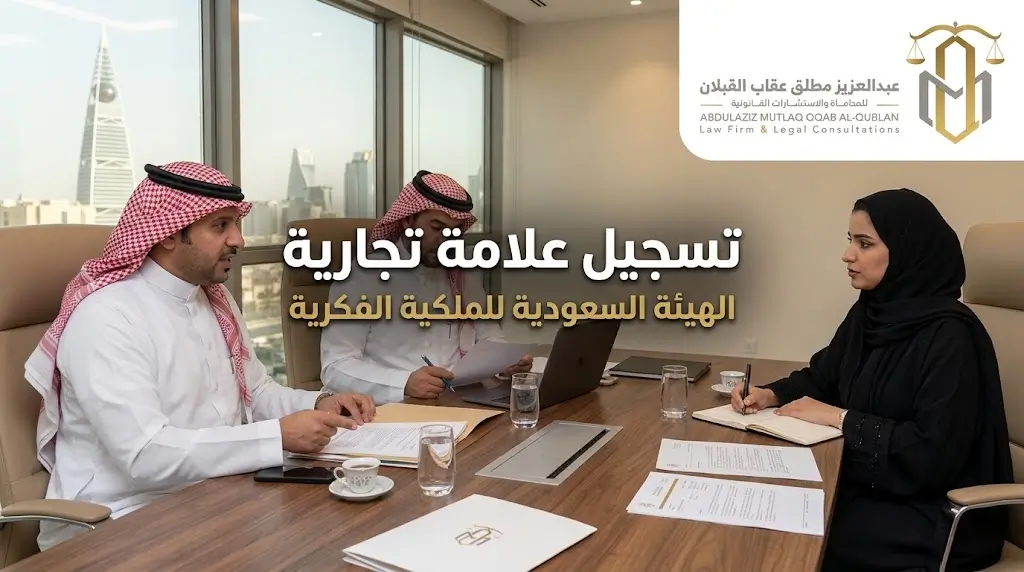
The procedure for trademark registration with the Saudi Authority for Intellectual Property is conducted electronically via the unified SAIP digital portal. It encompasses conducting a prior clearance search under the international Nice Classification, formal and substantive examination filings, settlement of statutory fees, an official 60-day gazette publication and opposition period, and the final grant of a 10-year renewable protection certificate, complete with legal standing to litigate opposition and infringement claims before Saudi Commercial Courts.
- 1. Statutory Significance of Trademarks and the Protective Legal Framework
- 2. Conditions, Requirements, and Step-by-Step Filing Procedures with SAIP
- 3. Role of Formal and Substantive Examination under the Nice Classification
- 4. Statutory Fees, Filing Costs, and Decennial Renewal Schedules
- 5. Prior Clearance Searches and Verifying Freedom to Operate
- 6. Publication Protocol, 60-Day Opposition Window, and Certificate Grant
- 7. Countering Infringement, Counterfeiting, and Commercial Court Litigation
- 8. Title Assignments, Commercial Licensing, Cancellation, and Grace Periods
- 9. International Trademark Protection via the Madrid Protocol and WIPO
- 10. Legal Distinction: Registered Trademark vs. Commercial Trade Name
- 11. Our Firm’s Strategic Framework in Protecting Intellectual Property Rights
- 12. Comprehensive Appraisal of Registration Obstacles and Technical Overcomes
- 13. Enterprise Representation and Institutional Brand Protection
- 14. Integrated Commercial and Legal Safeguards for Brand Equity
- 15. Statutory Guarantees of Accredited Trademark Protection
- Frequently Asked Questions
- Conclusion
📞 Call Us |
1. Statutory Significance of Trademarks and the Protective Legal Framework
A trademark derives its legal and economic value as the distinctive commercial vehicle that identifies and segregates goods or services in commerce. Executing trademark registration with the Saudi Authority for Intellectual Property stands as the certified legal instrument for safeguarding the exclusive rights of corporate enterprises and commercial establishments against unfair practices designed to deceive consumers, cause market confusion, or free-ride on accumulated business goodwill across local and regional jurisdictions.
The governing regime affords absolute statutory protection to the registered proprietor upon issuance of the formal certificate of registration. This insulates commercial entities against unfair competition and substantially elevates market valuation, executed in continuous coordination with an accredited lawyer in Riyadh to administer intellectual and commercial assets across regulatory authorities and ministerial councils.
2. Conditions, Requirements, and Step-by-Step Filing Procedures with SAIP
Submitting an application for trademark registration necessitates strict adherence to statutory distinctiveness criteria and eligibility prerequisites established under Saudi intellectual property regulations, carried out via the following sequential workflow:
3. Role of Formal and Substantive Examination under the Nice Classification
Every submitted application undergoes rigorous administrative and legal scrutiny divided into two phases. The first is formal examination, which audits the sufficiency of submitted documentation, representation capacities, and fee payments. The second is substantive examination, which assesses the mark’s compliance with statutory registrability standards, ensuring it contains no legal bars under the GCC Trademark Law and aligns with the International Classification of Goods and Services (Nice Classification).
SAIP examiners verify that the mark does not conflict with religious emblems, state insignia, official flags, or public order and morality, and that it does not mislead consumers regarding the geographical origin, nature, or characteristics of the products or services. Furthermore, for multinational entities holding an official investment license, our practice cross-aligns licensed operational activities with corresponding Nice product classes to secure seamless market entry.
4. Statutory Fees, Filing Costs, and Decennial Renewal Schedules
The Authority imposes a structured statutory fee schedule corresponding to each administrative phase of the trademark’s life cycle. This begins with initial filing and examination fees, moves to electronic gazette publication charges upon preliminary acceptance, and concludes with final registration and certificate issuance fees:
- Filing and Examination Fees: Remitted upon lodging the application to trigger formal and substantive auditing by SAIP examiners.
- Official Gazette Publication Fees: Settled immediately following conditional or unconditional acceptance to initiate the 60-day statutory notice period.
- Final Registration and Grant Fees: Remitted upon expiration of the 60-day publication window without opposition, securing a 10-year official registration certificate.
- Periodic Decennial Renewals: Payable during the final year of the 10-year protection term, or within the 6-month statutory grace period subject to late renewal surcharges.
5. Prior Clearance Searches and Verifying Freedom to Operate
Conducting an exhaustive prior clearance search across SAIP database registries represents a critical strategic safeguard prior to filing. This diligence verifies the absence of identical or confusingly similar registered or pending marks that could trigger absolute or relative grounds for refusal, shielding enterprises from procedural delays and unrecoverable filing costs.
Specialized IP practitioners at the Law Firm of Abdulaziz Mutlaq Eqab Al-Qablan utilize search methodologies assessing phonetic, visual, and conceptual similarities across English and Arabic marks, reviewing overlapping product specifications under the Nice Classification to establish freedom to operate before filing.
6. Publication Protocol, 60-Day Opposition Window, and Certificate Grant
Upon passing substantive examination, the accepted application is published in the official intellectual property gazette for sixty calendar days. This publication window allows third parties demonstrating legitimate legal interest to file formal, substantiated opposition notices against the pending registration.
Should an opposition be filed, the applicant is served through the portal and granted thirty days to submit counter-statements. If no opposition is lodged, or if the SAIP Opposition Committee dismisses third-party claims, the applicant is directed to settle final registration fees, prompting the automated issuance of the certified Trademark Certificate granting exclusive rights across Saudi Arabia for ten Hijri/Gregorian operational years.
📞 Call Us |
7. Countering Infringement, Counterfeiting, and Commercial Court Litigation
Acquiring formal statutory title over a mark vests the proprietor with the right to initiate civil and criminal actions against infringers and counterfeiters before the Commercial Courts. Remedies include obtaining urgent preliminary injunctions to cease commercial usage, executing seizures over infringing consignments, ordering the destruction of counterfeits, and publishing court judgments in local media at the infringer’s expense.
Proprietors may also pursue monetary compensation for material and moral damage, accounting for profits derived through bad-faith exploitation. Our practice manages post-judgment enforcement by submitting an enforcement application before the Enforcement Courts, securing monetary restitution through debt enforcement measures.
8. Title Assignments, Commercial Licensing, Cancellation, and Grace Periods
The statutory framework permits the full or partial assignment of trademark ownership, executed alongside the underlying enterprise or independently, via notarized instruments that must be entered in the SAIP register to produce opposability against third parties. Similarly, proprietors may grant exclusive or non-exclusive commercial licenses, incorporating mandatory quality control terms and territorial boundaries.
Drafting assignment deeds, commercial franchise agreements, and license agreements requires specialized guidance from a dedicated contract drafting lawyer to preserve underlying asset values. In addition, registered marks face cancellation lawsuits if left unused for five consecutive years without legitimate statutory justification.
9. International Trademark Protection via the Madrid Protocol and WIPO
Saudi Arabia’s accession to the Madrid Protocol allows domestic and foreign-owned enterprises holding an active application or registration before SAIP to seek international protection across more than 130 countries via a single standardized application submitted through the World Intellectual Property Organization (WIPO).
This international framework reduces cross-border filing costs and procedural timelines by centralizing global administrative modifications, currency conversions, and renewals under one umbrella application, enabling Saudi enterprises to scale into foreign markets without retaining separate foreign counsel in each target jurisdiction.
10. Legal Distinction: Registered Trademark vs. Commercial Trade Name
Corporate founders frequently confuse commercial trade names with registered trademarks. The fundamental legal distinctions governing both assets are delineated below:
| Comparative Standard | Commercial Trade Name | Registered Trademark |
|---|---|---|
| Competent Regulatory Entity | Ministry of Commerce (Commercial Register). | Saudi Authority for Intellectual Property (SAIP). |
| Statutory Scope and Purpose | Identifies and designates the corporate legal entity itself. | Distinguishes specific goods and services provided by the business. |
| Territorial Protection | Guaranteed within corporate registration perimeters. | Absolute nationwide proprietary protection across registered Nice classes. |
| Visual and Form Elements | Restricted to alphanumeric textual commercial titles. | Encompasses words, logos, symbols, colors, 3D shapes, and sounds. |
Corporate counsel at our firm, collaborating with an experienced corporate commercial attorney, consistently advise that trade name registration in the Commercial Register does not confer proprietary trademark rights, mandating independent filings before SAIP to prevent brand theft.
11. Our Firm’s Strategic Framework in Protecting Intellectual Property Rights
Our legal team at the Law Firm of Abdulaziz Mutlaq Eqab Al-Qablan structures end-to-end protective and remedial strategies. This covers brand monitoring to identify early infringements, preparing briefs against administrative refusal notices, and litigating before opposition panels and appellate commercial benches.
Our attorneys also handle judicial representation before First Instance and appellate benches, securing review before the Courts of Appeal to overturn unfavorable administrative or judicial findings in commercial disputes.
12. Comprehensive Appraisal of Registration Obstacles and Technical Overcomes
Executing trademark registration with the Saudi Authority for Intellectual Property requires a technical understanding of the statutory grounds for refusal raised by SAIP examiners. Our counsel navigates objections founded on descriptiveness, generic terminology, and visual or phonetic similarities, drafting responsive briefs that demonstrate acquired distinctiveness and commercial coexistence.
13. Enterprise Representation and Institutional Brand Protection
The Law Firm of Abdulaziz Mutlaq Eqab Al-Qablan provides representation for domestic and international corporations across all phases of intellectual property management, from registration to commercial litigation, safeguarding corporate assets and commercial standing.
14. Integrated Commercial and Legal Safeguards for Brand Equity
Our practice combines sector knowledge with legal precision to build intellectual property portfolios that insulate market value, mitigating risks related to debt execution or commercial disruptions.
15. Statutory Guarantees of Accredited Trademark Protection
Institutional asset security is achieved by meeting statutory compliance standards to finalize trademark registration with the Saudi Authority for Intellectual Property under the direction of certified attorneys and legal consultants at the Law Firm of Abdulaziz Mutlaq Eqab Al-Qablan.
📞 Call Us |
Frequently Asked Questions
What is the typical timeframe required to complete trademark registration?
The administrative timeframe spans between 3 to 6 months from the filing date to the issuance of the registration certificate, provided the mark encounters no office actions or third-party oppositions.
Can a trademark incorporating foreign non-Arabic words or scripts be registered?
Yes. Foreign scripts and terms are registrable under Saudi law provided they do not violate public order or morality, accompanied by Arabic transliterations and certified translations of foreign terms.
What formal recourse is available upon an administrative refusal by SAIP?
The applicant or their authorized legal representative may lodge an administrative grievance before the SAIP Grievance Committee within 60 days of official notification, with further appeals available before the Commercial Courts.
Does registration with SAIP confer worldwide intellectual property protection?
No. Registration with SAIP confers territorial protection exclusively within the borders of the Kingdom of Saudi Arabia. International expansion requires filing under the Madrid Protocol via WIPO or pursuing direct foreign national filings.
What statutory rights does a trademark registration certificate confer?
The certificate grants exclusive ownership rights to utilize the mark across registered classes, the standing to block and seize counterfeit imports at customs borders, and the legal basis to claim damages in infringement lawsuits.
How does the Law Firm of Abdulaziz Al-Qablan assist clients in trademark matters?
The Law Firm of Abdulaziz Mutlaq Eqab Al-Qablan provides representation: conducting prior clearance searches, drafting applications, countering oppositions, and litigating infringement and compensation claims before Commercial Courts.
Conclusion: Operational Retainer and Next Steps
Securing trademark registration with the Saudi Authority for Intellectual Property is essential to protect enterprise goodwill, deter counterfeiters, and establish proprietary asset value in the Saudi market. The Law Firm of Abdulaziz Mutlaq Eqab Al-Qablan (amq.com.sa) delivers the technical and courtroom capabilities to manage filings and litigate IP disputes. Secure certified legal counsel by contacting our practice via our online portal or by calling 0539999894.