
Extortion is one of the most dangerous crimes threatening the psychological and social stability of individuals. The Saudi legal system has paid special attention to it through clear and explicit provisions that define the extortion penalty in Saudi Arabia accurately, whether the extortion is financial, electronic, or via photos and videos. From Abdulaziz Mutlaq Eqab Al-Qablan Law Firm and Legal Consultations, here is everything related to this crime: its definition, elements, governing statutory provisions, the amount of the extortion penalty in Saudi Arabia and the circumstances that aggravate it, and how to report it properly.
- Extortion punishment in KSA
- Elements of the crime of extortion
- Statutory provision governing extortion
- Quantum of punishment under Article 3
- Aggravating factors for extortion
- Penalty for attempted extortion
- Extortion penalties linked to money laundering
- Confiscation and facility closure as supplementary penalties
- Types of extortion and corresponding penalties
- How to prove extortion before competent authorities
- Steps to report the crime of extortion
- Why hire a specialized extortion lawyer?
- Role of Abdulaziz Al-Qablan Law Firm in extortion cases
- Frequently asked questions
- Conclusion
Extortion penalty in Saudi Arabia
Extortion in essence is a behavior in which a person threatens another with harm to their reputation, privacy, or material or moral interests, aiming to compel them to execute a specific order, pay a sum of money, or provide an unwanted benefit. The fundamental difference between a simple threat and extortion lies in the requirement of consideration: if there is a bare threat without demanding anything in return, it is a simple threat crime. However, if the threat is coupled with a demand for money, a benefit, or a service, the incident transforms into a fully fulfilled crime of extortion.
The Saudi legislator did not leave this crime without explicit criminalization, but regulated it within the Anti-Cybercrime Law issued by Royal Decree No. M/17 dated 8/3/1428 AH, along with other Penal Law provisions dealing with cases not linked to technical means.
📞 Call Us |
Elements of the crime of extortion
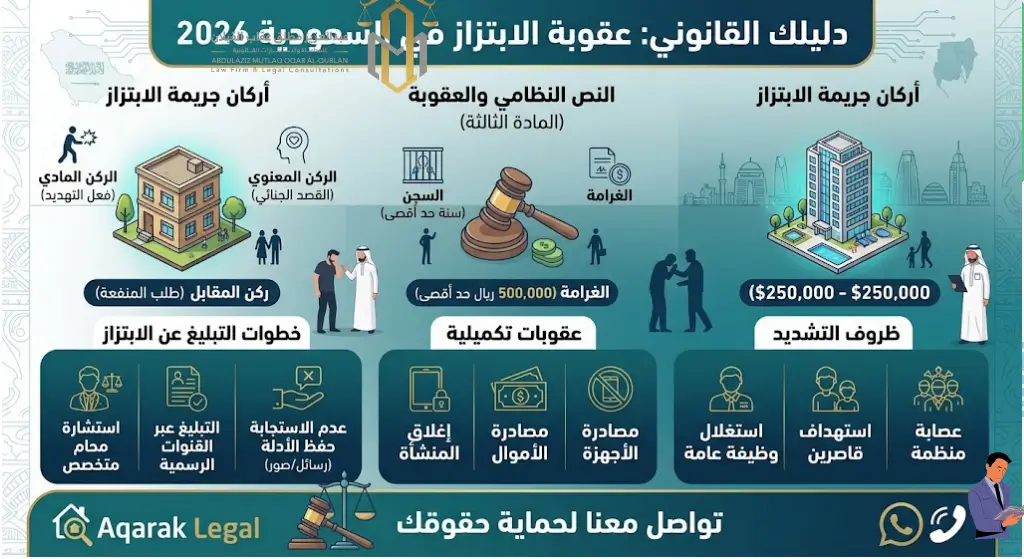
For the crime of extortion to be legally complete, three core elements must be present:
- Physical Element: The existence of an explicit or implicit threat act, whether via text message, phone call, post, or any other medium.
- Mental Element: Criminal intent possessed by the offender, knowing that their conduct constitutes a threat and desiring to achieve the outcome.
- Consideration Element: Demanding a sum of money, a benefit, or a specific service in return for ceasing or not executing the threat.
Statutory provision determining the extortion penalty in Saudi Arabia
Article 3 of the Anti-Cybercrime Law is the primary reference determining legal consequences when extortion is conducted through electronic means. This article criminalizes “unlawful access to threaten or blackmail any person to compel them to take or abstain from an action, even if taking or abstaining from such action is lawful.”
This final phrase is critical, as it clarifies that the crime stands even if the action required from the victim was originally lawful; the determining factor is the threatening method itself, not the legality of the demand.
Amount of the extortion penalty in Saudi Arabia according to Article 3
Article 3 specifies the punishment for extortion in Saudi Arabia as follows:
- Imprisonment for a period not exceeding one year.
- A financial fine not exceeding five hundred thousand Saudi Riyals.
- The judge may rule with either penalty or both according to case circumstances and gravity of harm.
If extortion involves violating privacy using a mobile phone or camera, such as threatening to publish photos or videos, the same penalty applies as an invasion of private life governed by paragraph 4 of the same article.
When is the extortion penalty in Saudi Arabia aggravated?
The law did not limit itself to a uniform punishment for all cases. Article 8 of the Anti-Cybercrime Law outlines aggravating circumstances that make the penalty for extortion in Saudi Arabia much harsher than the baseline penalty. According to this article, imprisonment or fines shall not be less than half of the statutory maximum limit in the following instances:
- Commission of the crime through an organized gang.
- Targeting minors or persons with disabilities.
- Exploitation of public office by the offender to carry out the crime.
- Prior convictions of the offender in similar crimes.
In other words, if the victim is a minor, or the offender an official exploiting authority, the court becomes obligated to raise the penalty threshold to no less than half the maximum limit—a mandatory statutory requirement rather than judicial discretion.
Penalty for attempted extortion
An offender may stop short of completing the crime due to circumstances beyond their control. Here, Article 10 of the same law establishes that anyone who attempts cyber extortion without completing execution shall be punished by a sentence not exceeding half the maximum limit prescribed for the full crime. Thus, merely attempting extortion, even if the message fails to reach the victim or no money is paid, warrants criminal prosecution.
Extortion penalty in Saudi Arabia when linked to money laundering
In certain major cases, extortion evolves into part of a broader network aimed at generating illicit gains and disguising their origin. Here, anti-money laundering regulations intervene. In such instances, penalties may reach up to ten years imprisonment and a fine of up to five million Saudi Riyals when money laundering elements are satisfied alongside extortion itself.
Confiscation and facility closure as supplementary penalties
In addition to imprisonment and fines, Article 13 empowers judges with discretionary authority to issue supplementary penalties reinforcing deterrence, including:
- Confiscation of Devices and Tools: such as phones and computers utilized in executing the crime.
- Confiscation of Proceeds: any financial sums obtained by the offender through extortion.
- Facility Closure: if extortion was committed from a workplace or specific facility, total or partial closure may be ordered for up to six months.
Issuing a confiscation order requires establishing criminal intent and bad faith on the part of the accused, without prejudice to rights of bona fide third parties.
📞 Call Us |
Types of extortion and how the appropriate penalty is determined for each
Manifestations of the crime differ depending on medium and objective, directly influencing case characterization before Public Prosecution and courts:
Financial Extortion
The offender threatens to expose secrets or personal information—even if non-indecent—in exchange for a specific sum. Demands often recur whenever the victim complies initially. The penalty for extortion stipulated in Article 3 applies fully here.
Extortion via Photos and Videos
One of the most widespread and psychologically distressing forms, where the offender threatens to publish private photos or videos on social media or send them to close associates. Penalties for privacy violation apply alongside basic extortion penalties, with sentences aggravated if actual publishing occurs.
Emotional Extortion
A more complex form exploiting emotional bonds or prior trust to push victims into unlawful or immoral actions through psychological manipulation, scandal threats, or harmful relationship termination.
Denial-of-Service Extortion
A technical variant targeting companies and websites, where offenders disrupt site operations via cyberattacks, demanding ransom payments to halt attacks and restore services.
How to prove extortion before competent authorities?
Many victims hesitate to report due to perceived evidentiary difficulties. However, practical experience demonstrates that the Saudi judicial system handles these cases strictly when clear evidence exists, including:
- Screenshots of threatening chats or text messages.
- Audio recordings of calls if available.
- Proof of prior financial transfers made under coercion.
- Witness testimony if third parties were aware of the incident.
- Technical reports from the Communications, Space and Technology Commission tracing message sources or accounts.
It is vital not to delete messages or chats regardless of distress, as Public Prosecution builds investigation and indictment decisions upon this evidence.
Steps to report the crime of extortion
Upon facing extortion attempts, following these steps without delay is advised:
- Refrain from complying with demands financially or otherwise, as compliance rarely ends the problem and invites larger demands.
- Preserve all case-related evidence prior to approaching authorities.
- Report through official channels designated for cyber extortion, enabling documented reports directly reaching investigation bodies.
- Consult a specialized lawyer in criminal and cyber cases to accompany the victim across all stages, from investigation to judgment.
- Track case progress before Public Prosecution through to referral to the competent Criminal Court if necessary.
Why do you need a lawyer specialized in extortion cases?
Some may presume extortion cases are simple and require no legal counsel. However, reality dictates that these cases demand high precision in gathering evidence, legally drafting complaints accepted by courts, and understanding nuances between simple threats and extortion, as well as mitigating vs. aggravating circumstances affecting sentences. Furthermore, certain cases require direct coordination with communications authorities to trace perpetrators, particularly regarding anonymous or offshore accounts.
At Abdulaziz Mutlaq Eqab Al-Qablan Law Firm and Legal Consultations, our legal team specialized in criminal cases and cybercrimes examines each case individually, building tailored defense or prosecution strategies protecting client rights—whether a victim seeking justice and imposing the maximum extortion penalty in Saudi Arabia on the offender, or a defendant requiring robust defense safeguarding statutory rights.
Role of Abdulaziz Mutlaq Eqab Al-Qablan Firm in extortion cases
The firm delivers integrated legal services for handling extortion across its various forms:
- Thoroughly evaluating available evidence and assessing legal standing.
- Drafting formal complaints and statements of claim correctly.
- Following up on cases before Public Prosecution and security agencies.
- Providing full legal representation before Criminal Courts until final judgment issuance.
- Delivering immediate consultations via phone or WhatsApp to evaluate positions before taking official steps.
Our team combines practical experience with deep knowledge of the latest updates in Saudi cybercrime regulations, offering clients complete confidence throughout every phase.
📞 Call Us |
Frequently asked questions
Can an extortion case be dropped after filing?
Certain extortion crimes fall under public right claims, which are not dropped by private waiver alone—especially when accompanied by aggravating circumstances. In other scenarios, waivers may affect case progression. Consulting a lawyer to understand precise legal consequences in each scenario is always advised.
What is the difference between a threat and extortion under Saudi Law?
A bare threat without requesting consideration is treated as a standalone threat crime. However, if the threat is coupled with demanding money, benefits, or services, it transforms into extortion punishable under Article 3 of the Anti-Cybercrime Law.
Is the punishment for extortion uniform across all cases in Saudi Arabia?
No. The baseline penalty involves imprisonment up to one year and a fine up to SAR 500,000. However, sentences are aggravated if linked to specific circumstances like targeting minors, abusing public office, or recidivism, reaching up to 10 years imprisonment and SAR 5,000,000 fine in money laundering scenarios.
Can a perpetrator be punished even if they do not receive requested funds?
Yes. The law punishes attempted crimes as well, with sentences up to half the statutory maximum limit for completed crimes, even if the offender fails to obtain the demanded consideration.
How do I prove I am an extortion victim without written evidence?
Even without written messages, audio recordings, witness testimony, or technical reports from competent authorities can trace threat sources. Thus, immediate lawyer consultation upon facing extortion is strongly recommended, even if evidence initially appears limited.
Conclusion
The extortion penalty in Saudi Arabia came clear and strict to protect individuals from all forms of intimidation and exploitation, whether financially, emotionally, or technologically motivated. The legal framework leaves no loopholes for offenders, imposing severe penalties when targeting vulnerable groups and criminalizing attempted extortion itself. If you face extortion or require legal representation in a similar case, taking swift action and engaging a specialized attorney is the crucial step to protecting your rights and restoring legal and psychological security.
Contact Abdulaziz Mutlaq Eqab Al-Qablan Law Firm and Legal Consultations at 0539999894, or via email at info@amq.com.sa.